MAKE A RESERVATION
 Blog
Blog 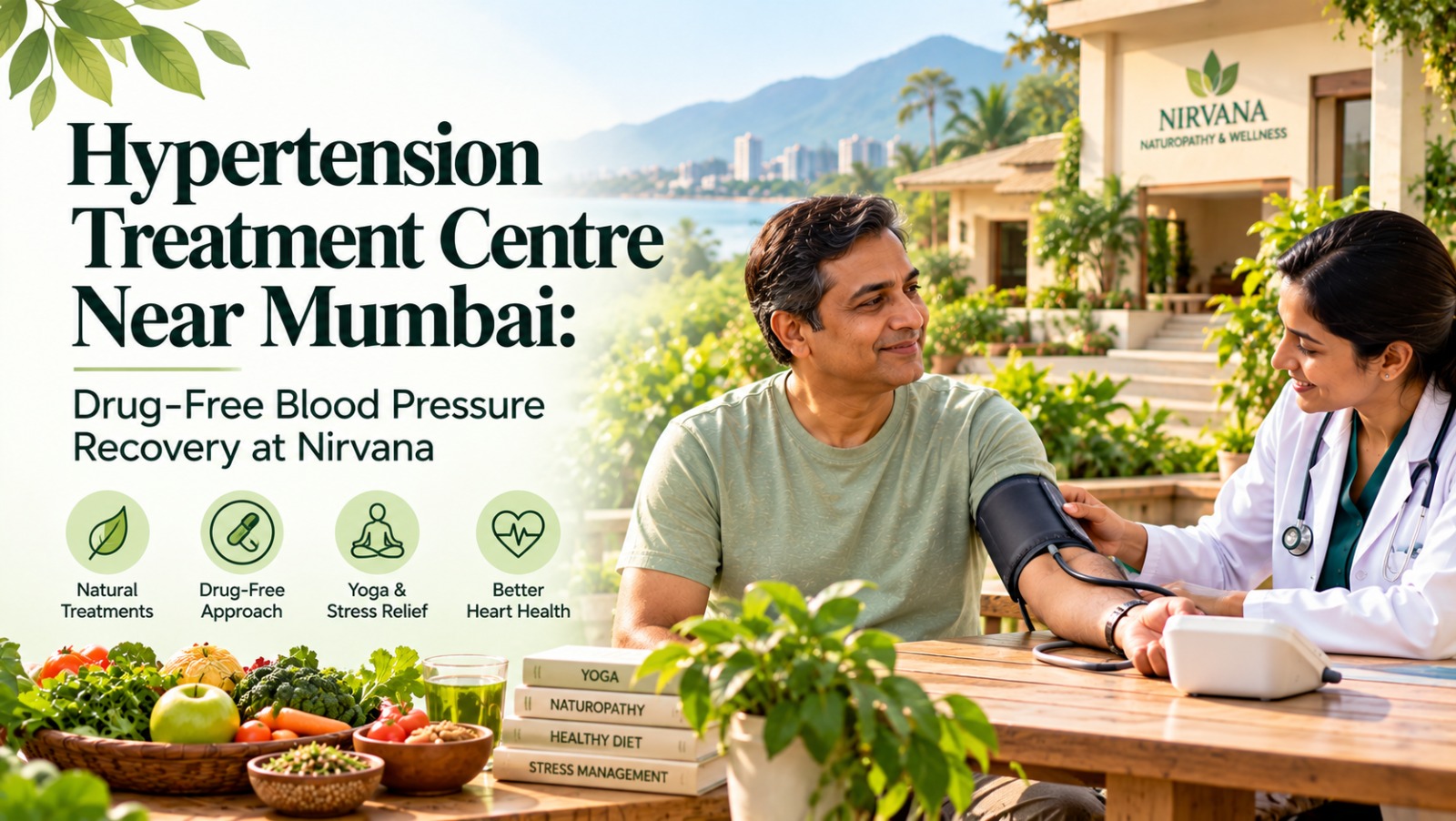
 October 17, 2026
 by
by Table of Contents
- Why Mumbai Has a Blood Pressure Problem
- What a Real Hypertension Treatment Centre Near Mumbai Should Offer
- How the Programme at Nirvana Works
- Results and What to Realistically Expect
- Getting Here, Programme Options and Costs
- Frequently Asked Questions
There is a particular pattern we see repeatedly at our centre. A working professional in their forties, based in Mumbai or Pune, diagnosed with high blood pressure three or four years ago. Started on one tablet. Now on two, possibly three. Readings still not quite where the doctor wants them. Nobody has ever discussed anything beyond adjusting the prescription.
Medication is genuinely valuable and has prevented an enormous number of strokes. But it lowers the reading without touching what produces it: the sodium load from daily eating, the sustained stress of urban working life, the weight gained over a decade of desk work, the disrupted sleep, and the near total absence of movement. Which is why doses so often rise over the years rather than falling.
A residential hypertension treatment centre near Mumbai addresses exactly this. Nirvana Naturopathy Ayurveda Hospital and Retreat in Igatpuri, 120 kilometres from Mumbai, is AYUSH certified, NABH pre accredited, and has been treating hypertension as a reversible lifestyle condition since 2014, with blood pressure measured every single morning so progress is visible rather than assumed.
Why Mumbai Has a Blood Pressure Problem
India has an estimated 220 million people living with hypertension, and urban centres like Mumbai carry more than their share for reasons that are entirely structural rather than personal.
Sodium intake in most Mumbai diets runs close to double the recommended limit, driven far more by restaurant food, packaged snacks, pickles, papad, and bakery items than by salt added at home. Commute times of two to three hours daily eliminate both exercise and sleep. Occupational stress produces sustained sympathetic nervous system activation, which is a direct physiological driver of raised pressure.
Add sedentary desk work, irregular late dinners, and alcohol as a stress outlet, and you have precisely the conditions that produce hypertension in people who are otherwise young and healthy. The World Health Organization identifies each of these as modifiable risk factors, which is the encouraging part of an otherwise concerning picture.
What a Real Hypertension Treatment Centre Near Mumbai Should Offer
Not every wellness facility is equipped to treat hypertension properly, and there are specific things worth checking.
Daily blood pressure monitoring is non negotiable. If a centre is not measuring your readings every morning, it cannot safely adjust your therapy or your medication, and it cannot show you whether anything is working. This single criterion eliminates a large proportion of options.
Qualified resident doctors matter equally, because medication adjustment in hypertension requires clinical judgement. Abrupt withdrawal of antihypertensives causes rebound hypertension, which is genuinely dangerous, so any dose change must be gradual and supervised.
A genuinely low sodium therapeutic kitchen is the third requirement, and it is harder to find than it sounds. Many wellness centres serve healthy food that is still salted normally. Effective hypertension treatment requires a kitchen that can prepare essentially salt free meals that remain palatable.
Finally, look for a programme that treats stress as a clinical variable rather than an amenity, because for a significant proportion of urban professionals stress is the primary driver rather than diet.
How the Programme at Nirvana Works
On arrival, your assigned BNYS or BAMS doctor reviews your readings history, current medications, kidney function, lipid profile, ECG if available, and full health history. Your treatment protocol is then prescribed individually.
Blood pressure is measured every morning under standardised conditions, and this reading drives the day’s decisions. The therapeutic kitchen prepares essentially salt free meals, high in potassium, magnesium, and nitrate rich vegetables including beetroot and leafy greens. Guests are often surprised how much the readings move in the first seventy two hours from this alone.
Daily therapies include neutral immersion baths and spinal spray, which reduce peripheral vascular resistance and sympathetic activation, and cold abdominal and spinal mud packs which stimulate vagal activity. Post treatment readings commonly show reductions of five to fifteen millimetres of mercury from a single session.
Yoga and pranayama run twice daily, with practices selected specifically for hypertension. Anulom Vilom, Bhramari, and Sheetali are used, while Kapalbhati, Bhastrika, breath retention, and full inversions are avoided, since these can raise pressure acutely. Shirodhara addresses the stress component directly, and for stress driven hypertension it is often the single most effective element of the programme.
Results and What to Realistically Expect
In a seven day programme, most guests with Stage 1 or Stage 2 hypertension see systolic pressure fall by ten to twenty five millimetres of mercury and diastolic by five to fifteen. Weight typically reduces by three to five kilograms, which itself contributes roughly one millimetre of mercury per kilogram lost.
In a fourteen day programme, normalisation below 130 over 80 without medication is a realistic outcome for Stage 1 hypertension. Guests on multiple medications frequently leave with reduced doses, always adjusted by our resident doctors based on daily readings rather than by guests themselves.
Being straightforward about limits matters here too. Guests with secondary hypertension caused by kidney or endocrine disease, established cardiac disease, or previous stroke require ongoing medication, and the programme works alongside it as supportive care. Sustaining results after discharge depends entirely on continuing the sodium, weight, movement, and stress protocol at home, which is why the discharge plan is built around your own measured response rather than generic advice.
Getting Here, Programme Options and Costs
Igatpuri is roughly two to two and a half hours from Mumbai by road via NH3 through Kasara Ghat. Igatpuri railway station is one kilometre from the campus with regular services from CSMT, and pickup can be arranged. Nashik is 55 kilometres away and Pune roughly four and a half hours.
Programmes run seven and fourteen days across five accommodation categories. Everything is included: doctor consultations, daily blood pressure monitoring, four therapies daily, all therapeutic meals, yoga and pranayama sessions, health education, and the discharge protocol. No separate therapy charges.
Seven days suits Stage 1 hypertension and stress driven cases. Fourteen days is recommended for Stage 2, long standing hypertension, guests on multiple medications, or hypertension alongside diabetes, obesity, or high cholesterol, which is the most common presentation we see.
What Makes the Residential Approach Work
It is worth being clear about why a week away produces what months of intermittent effort at home often does not, because the reason is practical rather than mysterious.
At home, the obstacles are structural. Family meals are cooked with normal salt, and cooking separately for one person rarely lasts. Work stress continues regardless of intention. Walking gets displaced by commute and deadlines. Dinner ends up late because that is when the day finishes. And crucially, there is no daily reading showing whether anything is working, so motivation depends on faith rather than evidence.
A residential setting removes every one of those obstacles simultaneously. The kitchen prepares your food to a doctor prescribed specification, so compliance is not a daily act of willpower. Therapies are administered on schedule. Yoga happens because it is on the timetable. Dinner is early because that is when it is served. And your blood pressure is measured every morning, so you see the effect of yesterday in today’s number.
That last point matters more than anything else. Watching your own reading fall from 158 to 142 to 134 across a week is a fundamentally different experience from being told that lifestyle change helps. It converts an abstract instruction into something you have personally observed working on your own body, and that is what makes the home protocol stick after discharge.
Speak to a Doctor Before You Book
If your blood pressure has been creeping up despite medication, a structured residential programme may be the missing layer. Contact us for a free pre admission consultation to discuss your readings, your medications, and which programme length suits your situation, and book your programme.
Frequently Asked Questions
Which is the best hypertension treatment centre near Mumbai?
The criteria that matter most are daily blood pressure monitoring, resident qualified doctors who can safely adjust medication, a genuinely low sodium therapeutic kitchen, and a documented track record. Nirvana in Igatpuri holds AYUSH certification and NABH pre accreditation, has operated since 2014, and carries a 4.9 star rating from over 3,363 verified reviews.
Can high blood pressure be cured at a naturopathy centre?
Stage 1 hypertension driven by lifestyle factors can frequently be normalised and maintained without medication when the underlying drivers are corrected and the changes sustained. Stage 2 hypertension usually requires medication initially, with dose reduction possible over time. Secondary hypertension caused by kidney or endocrine disease requires treatment of that underlying condition.
Will my BP medication be stopped during treatment?
Not abruptly and never independently. Antihypertensive medication continues on arrival, and any reduction is made gradually by our resident doctors based on daily monitored readings. Abrupt withdrawal causes rebound hypertension which is genuinely dangerous, so this is handled carefully and only when readings clearly support it.
How quickly does blood pressure come down at a residential programme?
Faster than most guests expect. Significant sodium reduction produces measurable change within seventy two hours. Hydrotherapy and mud therapy sessions often produce five to fifteen millimetre reductions individually. Most guests see clear improvement within the first four to five days, with the full seven day effect typically reaching ten to twenty five millimetres of mercury systolic.
Is the programme suitable if I also have diabetes and high cholesterol?
Yes, and this combination is extremely common because hypertension, diabetes, and dyslipidaemia share the same metabolic root in insulin resistance. A single programme addresses all three simultaneously rather than treating them separately, and guests with multiple conditions are monitored daily for blood sugar as well as blood pressure.